



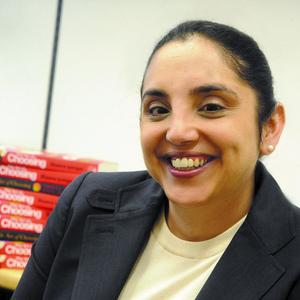

Sheena Iyengar
- Media Contact
Sheena S. Iyengar is a world expert on choice and decision-making. Her book "The Art of Choosing" received the Financial Times and Goldman Sachs Business Book of the Year 2010 award, and was ranked #3 on the Amazon.com Best Business and Investing Books of 2010. Her research is regularly cited in the New York Times, Wall Street Journal, and The Economist, as well as in popular books such as Malcolm Gladwell’s "Blink" and Aziz Ansari’s "Modern Romance." Dr. Iyengar has also appeared on television, including the Today Show, the Daily Show, and Fareed Zakaria’s GPS on CNN. Her TED Talks have collectively received nearly four million views, and her research continues to inform markets, businesses, and individuals around the world.
Dr. Iyengar is the inaugural S.T. Lee Professor of Business in the Management Division at Columbia Business School. Growing up in New York City as a blind Indian American and the daughter of immigrants, she reflected on the choices she and others had and how to get the most from choice. She first started researching choice as an undergraduate at the Wharton School of the University of Pennsylvania, where she graduated with a B.S. in Economics. She received her Ph.D. in Social Psychology from Stanford University, where her dissertation, "Choice and its Discontents," received the Best Dissertation Award. Dr. Iyengar received the Presidential Early Career Award in 2002, and in 2011 and 2019, she was named a member of the Thinkers50, a global ranking of the top 50 management thinkers. In 2012 she won the Dean’s Award for Outstanding Core Teaching from Columbia Business School and was named one of the World’s Best B-School Professors by Poets and Quants. She has also given keynotes and consulted for companies as wide ranging as Deloitte, Google, Bloomberg, Blizzard Entertainment, J.P. Morgan & Chase, and The North Face.
In a groundbreaking, new course called "Think Bigger," Professor Iyengar created a six step method for teaching people how to take advantage of lessons learned from neurological and cognitive science. She published a book by the same name in 2021.
Primary Interests:
- Culture and Ethnicity
- Judgment and Decision Making
- Motivation, Goal Setting
- Organizational Behavior
- Persuasion, Social Influence
Note from the Network: The holder of this profile has certified having all necessary rights, licenses, and authorization to post the files listed below. Visitors are welcome to copy or use any files for noncommercial or journalistic purposes provided they credit the profile holder and cite this page as the source.
Image Gallery


Video Gallery

The Art of Choosing
Select video to watch
-
27:18 The Art of Choosing
Length: 27:18
-
16:06 How to Make Choosing Easier
Length: 16:06
-
12:16 Fate, Chance, or Choice
Length: 12:16
-
20:53 Individuality, Choice, and Freedom
Length: 20:53
-
22:54 Chaos and Complexity of Choice
Length: 22:54
-
1:00:47 The Art of Choosing
Length: 1:00:47
-
2:38 "The Art of Choosing"
Length: 2:38
-
29:44 Every Fortune 500 Company Will Be Doing This in 10 Years
Length: 29:44
-
29:58 An Insight, an Idea
Length: 29:58
-
0:51 The Importance of Choice Today
Length: 0:51
-
30:43 The Art and Science of Choosing Wisely
Length: 30:43
-
9:13 You Had to Get on Your Own Two Feet
Length: 9:13
-
1:24:25 Lead by Choice
Length: 1:24:25
-
25:35 The Obligation to Choose
Length: 25:35
-
57:56 Choice and Authenticity
Length: 57:56
-
4:10 The Power of Choice
Length: 4:10
Additional Videos
Books:
- Iyengar, S. (2023). Think bigger: How to innovate. New York: Columbia University Press.
- Iyengar, S. S. (2010). The art of choosing. New York: Twelve.
Journal Articles:
- Ames, D. R., & Iyengar, S. S. (2005). Appraising the unusual: Framing effects and moderators of uniqueness-seeking and social projection. Journal of Experimental Social Psychology, 41(3), 271-282.
- Botti, S., & Iyengar, S. S. (2004). The psychological pleasure and pain of choosing: When people prefer choosing at the cost of subsequent outcome satisfaction. Journal of Personality and Social Psychology, 87(3), 312-326.
- Botti, S., Orfali, K., & Iyengar, S. S. (2009). Tragic choices: Autonomy and emotional responses to medical decisions. Journal of Consumer Research, 36(3), 337-352.
- Fisman, R., Iyengar, S. S., Kamenica, E., & Simonson, I. (2006). Gender differences in mate selection: Evidence from a speed dating experiment. Quarterly Journal of Economics, 121(2), 673-697.
- Fisman, R., Iyengar, S. S., Kamenica, E., & Simonson, I. (2008). Racial preferences in dating. Review of Economic Studies, 75(1), 117-132.
- Iyengar, S. S., & Lepper, M. R. (1999). Rethinking the value of choice: A cultural perspective on intrinsic motivation. Journal of Personality and Social Psychology, 76, 349-366.
- Iyengar, S. S., & Lepper, M. R. (2000). When choice is demotivating: Can one desire too much of a good thing? Journal of Personality and Social Psychology, 79, 995-1006.
- Iyengar, S. S., Wells, R. E., & Schwartz, B. (2006). Doing better but feeling worse: Looking for the "best" job undermines satisfaction. Psychological Science, 17(2), 143-150.
- Mogilner, C., Rudnick, T., & Iyengar, S. S. (2008). The mere categorization effect: How the presence of categories increases choosers' perceptions of assortment variety and outcome satisfaction. Journal of Consumer Research, 35(2), 202-215.
- Pöhlman, C., Carranza, E., Hannover, B., & Iyengar, S. S. (2007). Repercussions of self-construal for self-relevant and other-relevant choice. Social Cognition, 25(2), 284-305.
- Sethi, S., & Seligman, M. E. P. (1993). Optimism and fundamentalism. Psychological Science, 4, 256-259.
- Wells, R. E., & Iyengar, S. S. (2005). Positive illusions of preference consistency: When remaining eluded by one's preferences yields greater subjective well-being and decision outcomes. Organizational Behavior and Human Decision Processes, 98(1), 66-87.
Other Publications:
Courses Taught:
- Advanced Seminar in Organizational Behavior and Theory
- Entrepreneurial Creativity
- Innovation Salon
- Leadership Development
- Managerial Decision Making
- Perspectives on Authenticity
- Research Methods
- Think Bigger
- Thinking Globally
Sheena Iyengar
Columbia Business School
322 Kravis Hall
665 West 130th Street
New York, New York 10027
United States of America
- Phone: (212) 854-8539
